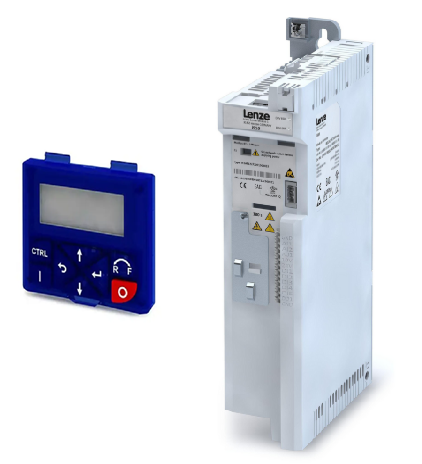
The Lenze i510 is a compact inverter designed to control the speed and operation of electric motors in a wide range of machine applications.
As part of the Lenze i500 inverter family, the i510 provides a practical solution for applications where reliable motor control, compact installation and straightforward commissioning are important.
It can be used in applications such as conveyors, material handling equipment, pumps, fans, packaging machinery and general industrial automation.
Selecting the correct inverter still depends on the motor, application and control requirements. However, the Lenze i510 can be a suitable option for many machines where a compact cabinet-mounted drive is required.
What is the Lenze i510 inverter?
The Lenze i510 is a variable frequency drive, also known as a variable speed drive or inverter.
It controls the speed of an AC motor by adjusting the frequency and voltage supplied to the motor.
This allows the machine to operate at the speed required by the application rather than simply running the motor at its fixed mains frequency.
Using an inverter can provide benefits such as:
- Adjustable motor speed
- Controlled acceleration
- Controlled deceleration
- Reduced mechanical shock
- Improved process control
- More flexible machine operation
- Motor protection functions
- Easier integration into an automated control system
The i510 is part of the wider Lenze i500 range, alongside the Lenze i550.
The i510 and i550 share the same general product family, but they are intended for different levels of application requirement and drive functionality.
Where is the Lenze i510 used?
The i510 may be suitable for a variety of industrial machines and equipment.
Typical applications can include:
- Conveyors
- Material handling equipment
- Pumps
- Fans
- Packaging machinery
- Processing equipment
- Simple production machinery
- Machine tools
- Industrial automation equipment
- General-purpose motor control
The suitability of the i510 depends on the actual load and operating conditions.
For example, a conveyor carrying a consistent load may have very different requirements from a machine that starts and stops frequently, accelerates heavy loads or requires accurate positioning.
The inverter should therefore be selected according to the complete application rather than the motor power alone.
Compact cabinet-mounted installation
One of the key advantages of the Lenze i510 is its compact design.
The cabinet-mounted format can be useful where space inside a control panel is limited.
When designing the panel, the following should be considered:
- Inverter dimensions
- Required clearance
- Heat dissipation
- Cable routing
- Motor cable length
- Incoming supply connections
- Control wiring
- Access for commissioning
- Access for future maintenance
Although the inverter may be compact, it still needs to be installed correctly.
The control panel must provide suitable ventilation and heat management, and the manufacturer’s installation requirements should always be followed.
Lenze i510 power range
The Lenze i510 cabinet range is available in motor power ratings up to approximately 15 kW at 400 V, depending on the exact product configuration.
The correct rating must be selected using the motor’s actual:
- Rated power
- Rated current
- Voltage
- Frequency
- Operating duty
- Load characteristics
Motor current is particularly important.
Two motors with similar power ratings may have different current requirements, and the inverter must be capable of supplying the required current under the expected operating conditions.
The inverter should not be selected solely because its kilowatt rating appears to match the motor.
Motor control with the Lenze i510
The i510 can be used for variable speed control in suitable AC motor applications.
The required control method depends on the motor and the performance needed from the machine.
For a basic application, the main requirement may simply be:
- Start
- Stop
- Forward rotation
- Reverse rotation
- Speed adjustment
More demanding applications may require additional functions, such as:
- Controlled acceleration
- Controlled deceleration
- Improved low-speed performance
- Torque control
- Braking
- Communication with a PLC
- Feedback or additional monitoring
The correct control method should be confirmed during the selection process.
Communication and control options
The way the i510 communicates with the rest of the machine depends on the selected drive configuration and available options.
A basic installation may use hardwired control signals for functions such as:
- Start
- Stop
- Enable
- Direction
- Speed reference
- Fault reset
Other applications may require communication with a PLC or automation system.
Before selecting the inverter, it is important to confirm:
- Which PLC or controller will be used
- Which communication system is required
- Whether digital or analogue signals are sufficient
- Whether network communication is necessary
- Whether additional options are required
- How faults and status information will be monitored
The communication requirements should be considered early, particularly where the inverter is being installed into a new control panel.
Commissioning a Lenze i510
Correct commissioning is important to ensure that the inverter and motor operate safely and as expected.
The i510 needs to be configured using the motor’s actual nameplate information.
This may include:
- Motor voltage
- Motor current
- Motor frequency
- Motor speed
- Motor power
- Acceleration time
- Deceleration time
- Minimum speed
- Maximum speed
- Direction of rotation
- Control source
- Speed reference source
Incorrect motor data or unsuitable drive settings can cause poor performance, nuisance trips or excessive motor heating.
The motor and inverter should also be checked for correct wiring, earthing and protection before the machine is put into operation.
Acceleration and deceleration
The Lenze i510 allows the motor to be started and stopped in a controlled manner.
Acceleration and deceleration settings can help reduce:
- Mechanical shock
- Belt slip
- Product movement
- Stress on couplings
- Stress on gearboxes
- Sudden changes in machine speed
The correct settings depend on the machine.
A lightweight conveyor may be able to accelerate quickly, while a machine with a large rotating mass may need a longer acceleration or deceleration time.
If the machine needs to stop quickly, the braking requirements must also be considered.
Braking requirements
Some applications need more than a normal controlled stop.
Braking may be required where the machine has:
- A high-inertia load
- Frequent stopping
- Short stopping times
- A heavy rotating assembly
- A vertical movement
- A requirement to hold a load
- A need to prevent unwanted movement
The braking method should be selected according to the application.
It is important to distinguish between electrical braking used to slow a motor and a mechanical holding brake used to hold a load in position.
Where a load must be held safely, the brake and machine safety system must be designed for that purpose.
Using the i510 in a control panel
The Lenze i510 can be integrated into a control panel as part of a wider motor-control system.
A typical installation may include:
- Main isolator
- Protective devices
- Inverter
- Motor protection and switching equipment where required
- Control power supply
- PLC or control system
- Terminal blocks
- Emergency-stop and safety circuits
- Motor and control cabling
The exact panel arrangement will depend on the machine and applicable electrical requirements.
The panel designer should also consider:
- Heat generated by the inverter
- Separation of power and control wiring
- EMC requirements
- Cable screening
- Earthing
- Access for maintenance
- Clear identification of terminals and cables
Correct panel design is important for reliable operation and easier future servicing.
Is the Lenze i510 suitable for your application?
The i510 may be suitable where the machine requires a compact inverter for general-purpose variable speed control.
It may be worth considering for applications that need:
- Adjustable motor speed
- Controlled starting and stopping
- Compact panel installation
- Straightforward motor control
- Integration with a machine control system
- A practical solution for standard industrial applications
However, the i510 may not be the best choice for every application.
A more demanding machine may require:
- Higher motor power
- More advanced communication
- Greater control performance
- Additional feedback
- More demanding braking
- More complex motion functions
- A different inverter configuration
This is where comparing the i510 with the Lenze i550 can be useful.
Lenze i510 or Lenze i550?
The Lenze i510 and i550 are both part of the Lenze i500 family, but they should not automatically be treated as interchangeable.
The i510 is generally considered where a compact inverter solution is required for suitable standard machine applications.
The i550 provides a wider range of options and is available in higher power ratings, making it suitable for more demanding applications.
The correct choice depends on factors such as:
- Motor power
- Motor current
- Required control performance
- Communication requirements
- Braking
- Feedback
- Application duty
- Installation arrangement
- Future expansion
For a broader comparison of the i500 range and guidance on selecting the correct inverter, see our main Lenze i500 selection guide.
What information is needed to select a Lenze i510?
To select the correct Lenze i510, it is useful to have details of:
- Motor make and model
- Motor power
- Motor voltage
- Motor current
- Motor frequency
- Motor speed
- Application description
- Required operating speed
- Duty cycle
- Number of starts and stops
- Acceleration and stopping requirements
- Braking requirements
- Communication requirements
- PLC or control system
- Installation arrangement
- Any existing inverter details
A photograph of the motor nameplate is often a useful starting point.
For the full list of information needed when selecting a Lenze inverter, see:
What Information Is Needed to Select a Lenze i500 Inverter?
Support from Modern Drives & Controls
Modern Drives & Controls can help with the selection and application of Lenze i510 inverters.
We can help review the motor and machine requirements and identify a suitable inverter for the application.
Support can include:
- Lenze i510 selection
- Motor and inverter compatibility
- Application requirements
- Control-panel integration
- Braking requirements
- Communication requirements
- Commissioning considerations
- Replacement or upgrade advice
- Electrical control-panel design
The correct inverter depends on more than the motor’s kilowatt rating. By considering the application, motor data, control system and installation requirements together, the drive can be selected more accurately.
Conclusion
The Lenze i510 is a compact variable speed inverter suitable for a range of industrial machine applications.
It can provide adjustable motor speed, controlled acceleration and deceleration, and integration into a wider machine control system.
The i510 is particularly worth considering where a compact cabinet-mounted inverter is required for a suitable standard motor-control application.
However, the correct selection should always consider the motor current, application duty, braking, communication, control requirements and installation conditions.
If you are designing a new machine or need help selecting a Lenze i510 inverter, contact Modern Drives & Controls to discuss your requirements.