
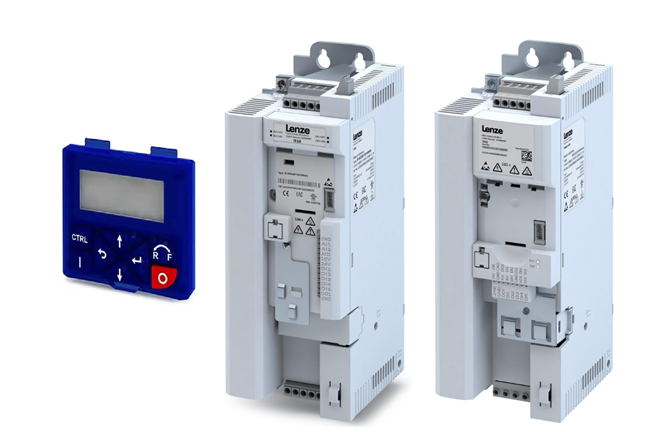
Selecting the correct inverter is an important part of designing, upgrading or maintaining an industrial machine.
The inverter must be suitable for the motor, but it also needs to meet the requirements of the application, control system, installation and safety arrangement.
The Lenze i500 inverter range provides flexible motor control solutions for a wide variety of industrial applications. The range includes different models and configurations, allowing the drive to be selected according to the requirements of the machine.
At Modern Drives & Controls, we can help you identify the most suitable Lenze inverter for your application.
What Is the Lenze i500 Inverter Range?
The Lenze i500 is a range of variable speed drives designed for industrial motor control and automation applications.
The range can be used to control the speed, torque and direction of electric motors in applications such as:
- Conveyors
- Pumps and fans
- Packaging machinery
- Material handling equipment
- Processing machinery
- Machine tools
- Production equipment
- Automated machinery
- Winding applications
- Other industrial motor control systems
The i500 range includes the Lenze i510 and Lenze i550, with each model offering different levels of functionality and application flexibility.
The correct choice depends on the motor, machine function, control requirements and installation conditions.
Lenze i510 vs i550 – What Is the Difference?
The Lenze i510 and i550 are both part of the i500 inverter family, but they are intended for different levels of application requirement.
The i510 is generally suited to applications requiring straightforward and reliable variable speed motor control.
The i550 is designed for applications where greater flexibility, additional functionality or more advanced integration may be required.
The following table provides a general comparison.
| Feature | Lenze i510 | Lenze i550 |
|---|---|---|
| Main purpose | Straightforward variable speed control | Flexible and scalable industrial motor control |
| Typical applications | Conveyors, pumps, fans and simpler machinery | More demanding machinery and integrated automation systems |
| Approximate power range | 0.25–15 kW | 0.25–132 kW, depending on configuration |
| Installation | Cabinet-mounted | Cabinet-mounted and decentralised options |
| Control requirements | Suitable for relatively simple control arrangements | Suitable for more advanced control and communication requirements |
| Communication | Selected communication options depending on configuration | Wider range of communication and networking options depending on configuration |
| Application flexibility | Best suited to applications with straightforward requirements | Suitable for applications requiring additional configuration and functionality |
| Safety and braking | Depends on selected model and application | Depends on selected model and application |
| Best starting point | Simple motor control applications | More flexible or demanding machine applications |
These differences are intended as a general guide. The exact specification must always be checked against the motor, application and control system.
When Is the Lenze i510 Suitable?
The Lenze i510 may be suitable where the machine requires reliable variable speed control without the need for a more extensive range of functions.
Typical applications may include:
- Basic conveyors
- Pumps
- Fans
- Simple material handling equipment
- Machines with straightforward start, stop and speed control
- Applications using relatively simple control wiring
The i510 is worth considering when the application is clearly defined and the required control functions are relatively limited.
For more detailed information, see our dedicated article:
Lenze i510 Inverters link here
When Is the Lenze i550 Suitable?
The Lenze i550 may be more suitable where the machine requires greater flexibility, a wider range of communication options or additional application functionality.
Typical considerations may include:
- More complex machine control
- Integration with a PLC or industrial network
- More demanding application requirements
- Additional braking or safety requirements
- A need for greater configuration flexibility
- Cabinet or decentralised installation
- Higher motor power requirements
The i550 should be assessed against the complete machine specification rather than selected solely because it has a higher power range.
For more detailed information, see our dedicated article:
Lenze i550 Inverters link here
Which Lenze Inverter Should You Choose?
As a general guide:
- Choose the i510 when the application requires straightforward and reliable variable speed control.
- Consider the i550 when the application requires greater flexibility, more advanced integration or a wider range of configuration options.
- Check the motor current, not just the motor kW rating.
- Confirm the required communication network before ordering.
- Review braking and safety requirements at the design stage.
- Check whether the inverter will be installed inside a cabinet or close to the machine.
- For replacement applications, compare the existing control arrangement as well as the electrical rating.
A correctly specified i510 may be the most appropriate solution for one machine, while another machine may require the additional flexibility of the i550.
The final choice should be based on the complete application requirements.
What Information Is Needed to Select a Lenze Inverter?
Before selecting an inverter, it is useful to gather as much information about the motor and application as possible.
This helps avoid selecting a drive that is unsuitable for the machine or unnecessarily expensive.
1. Motor Details
The motor nameplate is one of the most useful sources of information.
Ideally, provide:
- Motor manufacturer
- Motor model
- Motor power rating
- Motor voltage
- Motor current
- Motor frequency
- Motor speed
- Motor type
- Motor connection
- Motor duty rating
The motor current is particularly important.
It is not always sufficient to select an inverter based only on the motor’s kW rating, as motors with the same power rating can have different current requirements.
2. Application Details
The inverter must be suitable for the job the motor is performing.
Useful information includes:
- What the motor is driving
- Required operating speed
- Required speed range
- Required torque
- Starting conditions
- Acceleration time
- Deceleration time
- Frequency of starting and stopping
- Load inertia
- Continuous or intermittent operation
- Any overload requirements
For example, a conveyor, pump, fan and hoist may all require different inverter considerations even when their motors have similar power ratings.
3. Control Requirements
The control method can have a major effect on the inverter specification.
Consider how the motor needs to be controlled:
- Start and stop signals
- Speed reference
- Digital inputs
- Analogue inputs
- Local keypad control
- PLC control
- Network control
- Motor feedback
- Direction control
- Preset speeds
- Automatic or manual operation
It is also important to establish whether the inverter will operate independently or form part of a wider machine automation system.
4. PLC and Communication Requirements
If the inverter is being controlled by a PLC or machine controller, the communication method needs to be confirmed before selecting the drive.
Questions to consider include:
- Which PLC or controller is being used?
- Is fieldbus communication required?
- Is the inverter controlled over Ethernet?
- Is a hardwired control arrangement acceptable?
- Is feedback or diagnostic information required?
- Does the machine need communication with other drives?
- Is the inverter being added to an existing network?
The selected inverter and communication option must be compatible with the control system.
This is particularly important when replacing an existing drive, as the original inverter may use a specific communication method or control arrangement.
5. Braking Requirements
Some applications require more than normal motor deceleration.
Braking requirements may be affected by:
- Load inertia
- Stopping time
- Frequency of stopping
- Vertical movement
- Regenerative energy
- Emergency stopping requirements
- Required braking performance
Applications involving high inertia, frequent stopping or lifting loads may need additional braking equipment or a different inverter configuration.
The braking arrangement should be assessed as part of the complete application rather than treated as an afterthought.
6. Safety Requirements
The machine’s safety system should be considered before selecting the inverter.
Depending on the application, requirements may include:
- Safe Torque Off
- Emergency stop integration
- Safety relay connection
- Safety PLC integration
- Guarding and interlocking
- Controlled stopping
- Isolation arrangements
The correct safety solution depends on the machine risk assessment and the overall safety design.
The inverter’s available safety functions must be checked against the actual requirements of the machine.
7. Installation Requirements
The installation environment can also affect the inverter selection.
Consider:
- Cabinet-mounted or decentralised installation
- Available panel space
- Ambient temperature
- Ventilation and cooling
- Protection rating
- Dust or moisture
- Cable lengths
- EMC requirements
- Supply voltage
- Available electrical capacity
- Installation position
A drive installed inside a control panel may have different requirements from one installed close to the motor on a machine.
Selecting the Correct Inverter Rating
The inverter must be capable of supplying the motor under the conditions in which it will operate.
When selecting the rating, consider:
- Motor current
- Motor power
- Normal operating load
- Overload demand
- Starting requirements
- Acceleration and deceleration
- Duty cycle
- Ambient temperature
- Installation conditions
The required overload capacity is especially important for applications where the motor may experience short periods of increased load.
Selecting an inverter that is too small can lead to nuisance trips, poor performance or premature failure.
Selecting one that is unnecessarily large may increase cost without providing a practical benefit.
The best choice is the inverter that meets the actual electrical and application requirements.
New Machine Applications
When selecting a Lenze inverter for a new machine, it is best to consider the motor, inverter and control system together.
This allows the following areas to be checked before equipment is ordered:
- Motor compatibility
- Required inverter rating
- Control method
- PLC communication
- Braking
- Safety
- Cabinet layout
- Cable requirements
- Future maintenance
- Commissioning requirements
Considering these details at the design stage can help reduce changes later in the project.
It can also make commissioning and future maintenance easier.
Replacing an Existing Inverter
Replacing an older inverter is not always a direct like-for-like exercise.
Even if the existing drive and motor have the same kW rating, the replacement may need to match several other requirements.
Useful information includes:
- Existing inverter manufacturer
- Existing inverter model
- Existing inverter rating
- Motor nameplate details
- Supply voltage
- Existing control wiring
- PLC or communication network
- Braking equipment
- Safety arrangement
- Physical dimensions
- Existing parameter settings
Photographs of the existing inverter, motor nameplate and control-panel wiring can also be helpful.
A replacement inverter may require changes to:
- Wiring
- Communication settings
- Control signals
- Parameters
- Mounting
- Braking equipment
- Safety connections
The existing application should therefore be reviewed before a replacement is specified.
Why Professional Inverter Selection Matters
Choosing an inverter based only on motor power can lead to problems during installation or commissioning.
A suitable selection should take account of the complete application, including:
- Electrical requirements
- Mechanical load
- Control method
- Communication
- Braking
- Safety
- Installation environment
- Future maintenance
Getting these details right at the specification stage can help reduce downtime, avoid unnecessary equipment costs and make the final installation more reliable.
How Modern Drives & Controls Can Help
Modern Drives & Controls can assist with the selection and supply of Lenze inverter solutions for industrial applications.
We can help with:
- Reviewing motor details
- Assessing application requirements
- Identifying a suitable inverter
- Comparing available Lenze options
- Checking control requirements
- Reviewing communication options
- Considering braking requirements
- Considering safety requirements
- Reviewing replacement applications
- Supporting control-panel projects
- Supplying associated motor and automation equipment
We can also help identify any additional information needed before a final inverter specification is confirmed.
Contact Modern Drives & Controls
If you need help selecting a Lenze i500 inverter, contact Modern Drives & Controls with the details of your motor and application.
Where possible, provide:
- Motor nameplate information
- Existing inverter details
- Application description
- Required speed and control method
- PLC or communication requirements
- Braking and safety requirements
- Installation details
We can then help review the requirements and identify a suitable Lenze inverter solution for your machine.
Modern Drives & Controls Ltd
Industrial inverters, geared motors, control panels and automation solutions.
What to Do When Your Lenze 8200 or 8400 Drive Becomes Obsolete